How to Build a 2026 Design Portfolio: Why You Need More Than Just Pixels
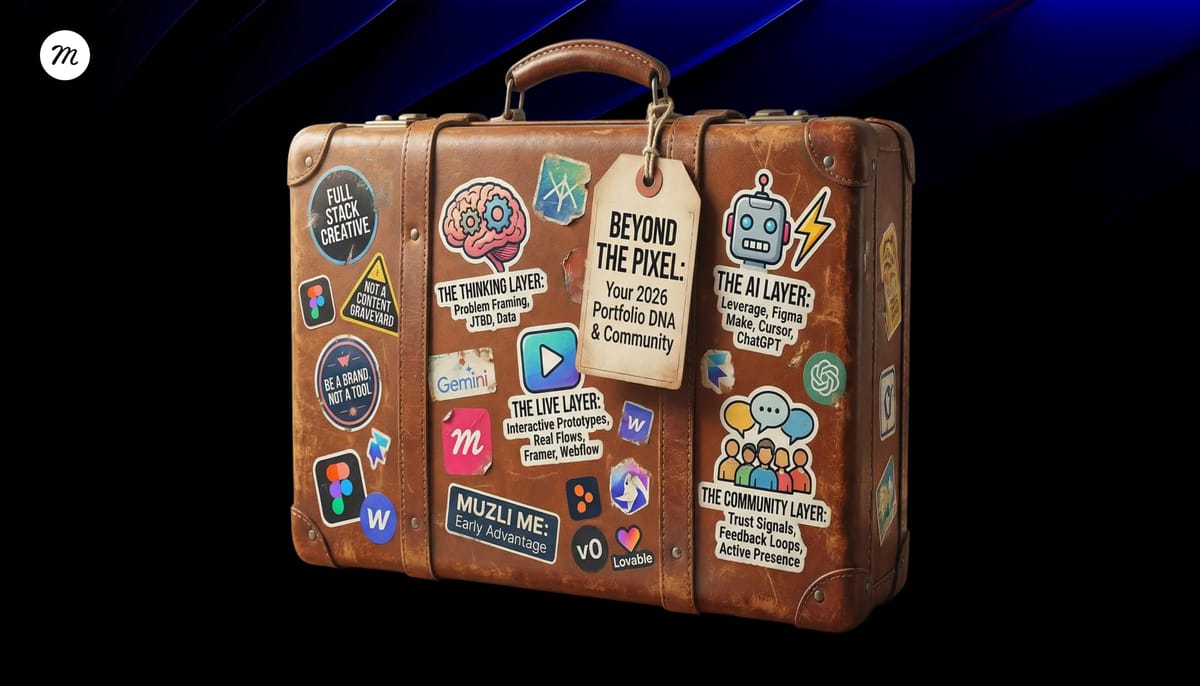
In 2026, a portfolio is no longer just a folder of “my best screens.”
It’s proof of how you think, how you build, how you adapt, and whether you can actually operate in the real world.
And yes, let’s put this on the table: great-looking design is still important.
Strong visuals open doors, create an instant first impression, and they will always help you stand out.
But in 2026, that’s only step one.
Today, clients and recruiters want to see beyond the screens: how you make decisions, how you move fast without losing quality, and what it looks like when your work has to function in real life, not just in a polished portfolio grid.
Because here’s the shift no one can ignore:
AI is making “good-looking UI” cheaper and more accessible.
So the market moved up the stack.
Teams aren’t only hiring pixel-perfect executors anymore. They’re looking for Full Stack Creatives, people who can design, write, prototype, prompt, and connect product goals to real user needs.
In other words:
They’re looking for your professional DNA.
Why Your Personal Website Might Be a Content Graveyard
A personal website can still be a great home base.
But for most designers in 2026, it quietly turns into a museum.
Not because the work isn’t good.
But because nobody sees it.
Designers spend weeks crafting custom portfolio sites, only to launch into silence:
- No traffic
- No shares
- No real discovery
Discoverability is currency now, and most hiring managers aren’t Googling your name. They’re scouting talent inside communities, in living feeds, where you can instantly see who’s active, who’s building, and who’s consistently delivering quality.
In 2026, a strong portfolio isn’t judged only by how it looks. It’s judged by how well it proves real working ability: product thinking, communication, AI collaboration, fast prototyping, and the ability to build consistency through a real design system, including day-to-day design system management and long-term maintenance across design and development.
A portfolio without distribution is like a great product without a launch.
The Anatomy of a Winning 2026 Portfolio: Your DNA Checklist
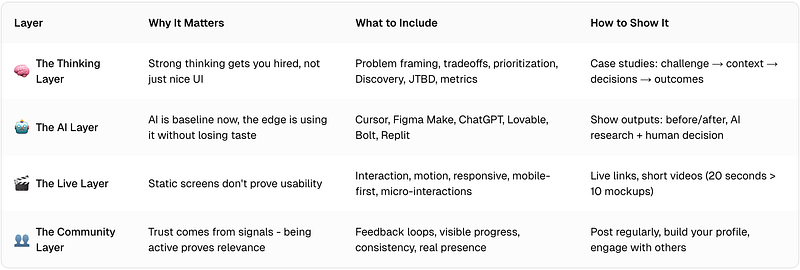
A strong portfolio today is layered.
It shows outcomes, but it also shows the system behind the outcomes.
Here are the four layers that turn “nice work” into “we should hire this person.”
The Thinking Layer
Why it matters in 2026
Great execution gets attention.
Strong thinking gets you hired.
Today, it’s not enough to show beautiful UI. Teams want to see if you can think like someone building real products:
- Can you frame real problems?
- Can you separate “looks good” from “works well”?
- Can you prioritize under constraints?
- Do you understand usability, data, and business impact?
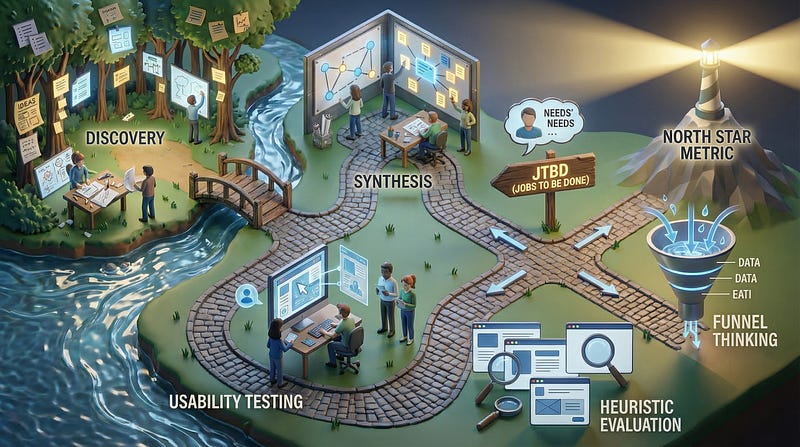
This is where methodologies become a real advantage: Discovery, Synthesis, Usability Testing, Heuristic Evaluation, working with JTBD, funnel thinking, and even concepts like a North Star Metric.
How to show it on Muzli Me
Give your screens a story.
Upload case studies that explain the problem, the constraints, and the reasoning behind your decisions, not just the final visuals. If you write on Medium or Substack, sync it and let your writing carry your strategic depth.
A simple structure that works every time:
What was the challenge?
What did you know (and what didn’t you know yet)?
What options did you explore?
What did you choose, and why?
What changed after it shipped?
The AI Layer
Why it matters in 2026
AI alone won’t impress anyone.
But knowing how to work with it well absolutely will.
Hiring teams don’t ask if you “use AI.” They look for whether you can produce high-quality work faster, without losing clarity, originality, or taste.
That often means being comfortable working inside modern workflows and tools like Figma Make, Cursor, Lovable, Bolt, Replit, v0 and using ChatGPT, Gemini and Claude as a real partner for research, ideation, writing, and rapid iteration.
The point isn’t the tool.
The point is leverage.
How to show it on Muzli Me
Don’t post “I used AI.”
Show what it enabled you to do.
Examples that actually work:
- Short iteration clips (before and after)
- AI-assisted research followed by a clear human decision
- Small product experiments that turned into something real
The goal is simple: show leverage, not gimmicks.
The Live Layer
Why it matters in 2026
Static images don’t prove functionality.
A UI can look perfect in a screenshot and still fall apart the moment someone clicks. Teams want to see that you can build complete experiences:
- interaction
- responsiveness
- motion
- flow
- micro-interactions
- mobile-first thinking
How to show it on Muzli Me
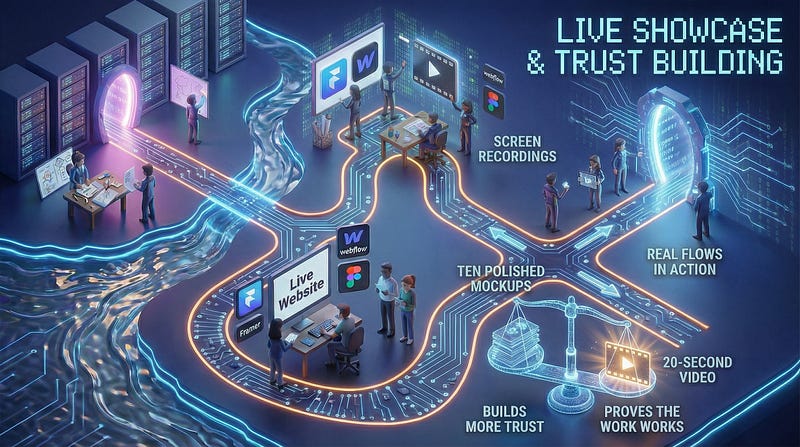
Link to live websites and interactive prototypes (Framer, Webflow, Figma), and upload short screen recordings that show real flows in action.
Sometimes a 20-second video builds more trust than ten polished mockups, because it proves the work actually works.
The Community Layer

Why it matters in 2026
Trust is built through signals, not claims.
When you’re active inside a real design community, it tells people a lot:
- you’re not working in isolation
- you’re exposed to feedback
- you’re improving in public
- you’re connected to what’s happening right now
It’s one of the fastest paths from “unknown designer” to “someone worth talking to.”
How to show it on Muzli Me
When you build your presence inside Muzli Me, your work doesn’t just sit somewhere online. It becomes part of a growing ecosystem where designers, teams, and decision makers actually browse.
You’re not only uploading a portfolio.
You’re placing yourself where discovery happens.
The Advantage of Joining Early (And Growing With the Platform)
In 2026, most major platforms feel like huge crowded cities.
There’s a lot of talent, but also a lot of noise, a lot of competition, and a lot of great work that disappears in minutes.
That doesn’t mean those platforms aren’t good.
It just means they’ve reached a stage where it’s harder to stand out.
Muzli Me is in a different phase.
It’s a young, growing platform, and that changes the game:
there’s more space for new names to rise, get discovered, and build momentum faster.
When an ecosystem is still growing, great work has more room to breathe. A profile can become something people genuinely discover, not because it’s from “the biggest creator,” but because the work is simply strong.
And the feed experience itself is built to give creators a fairer chance, not just the people who already have years of advantage. Our algorithm is designed to balance exposure across creators, styles, and content types, so strong work can reach the right people earlier.
One of our early members described it perfectly:
“Your platform is working great, I just got a client from it! I once tried using …….. , but it required me to sign up for a Pro account just to boost my visibility. Before I knew it, I had already spent over $165 and did not land a single client after more than 6 months. Your platform, on the other hand, feels much fairer for newcomers.”
That’s the early advantage.
You’re not arriving into a world that’s already divided between stars.
You’re growing with the platform.
Bottom Line: Don’t Be a Tool, Be a Brand
The designers who win in 2026 won’t be defined by the software they use.
They’ll be defined by what they consistently produce:
- how they think
- how they communicate
- how they execute
- how they evolve
Muzli Me lets you pull all of that into one place:
your shots, your stories, your live work, your experiments, your voice, and your momentum.
And if you’re building your identity in a new space, timing matters.
The earlier you show up, the easier it is to claim your name before it gets crowded.
Check if your professional username is still available, and start building your DNA today.
Looking for more daily inspiration? Download Muzli extension, your go-to source for everything design.
Related articles

Figma Just Opened the Canvas to AI Agents – Here’s What It Means for Designers

Lovable for Designers: The Complete Guide to Building Apps with AI (2026)

Google Just Introduced “Vibe Design” with Stitch. Here’s What It Means for UI Designers

Weekly Designers Update #543

15 AI Design Tools That Actually Change How You Work in 2026

From Design to Code Without Losing Context: An MCP-First Workflow

The Complete Vibe Coding Guide for Designers (2026)
More categories
Looking for more daily inspiration? Download Muzli extension your go-to source for design inspiration!
Get Muzli for Chrome


